Drain Cleaning Service · Centennial
Clearing Main Sewer Obstructions: Hydro Jetting vs Snaking in Centennial Properties
By , · Published August 31, 2026 · 1,802 words
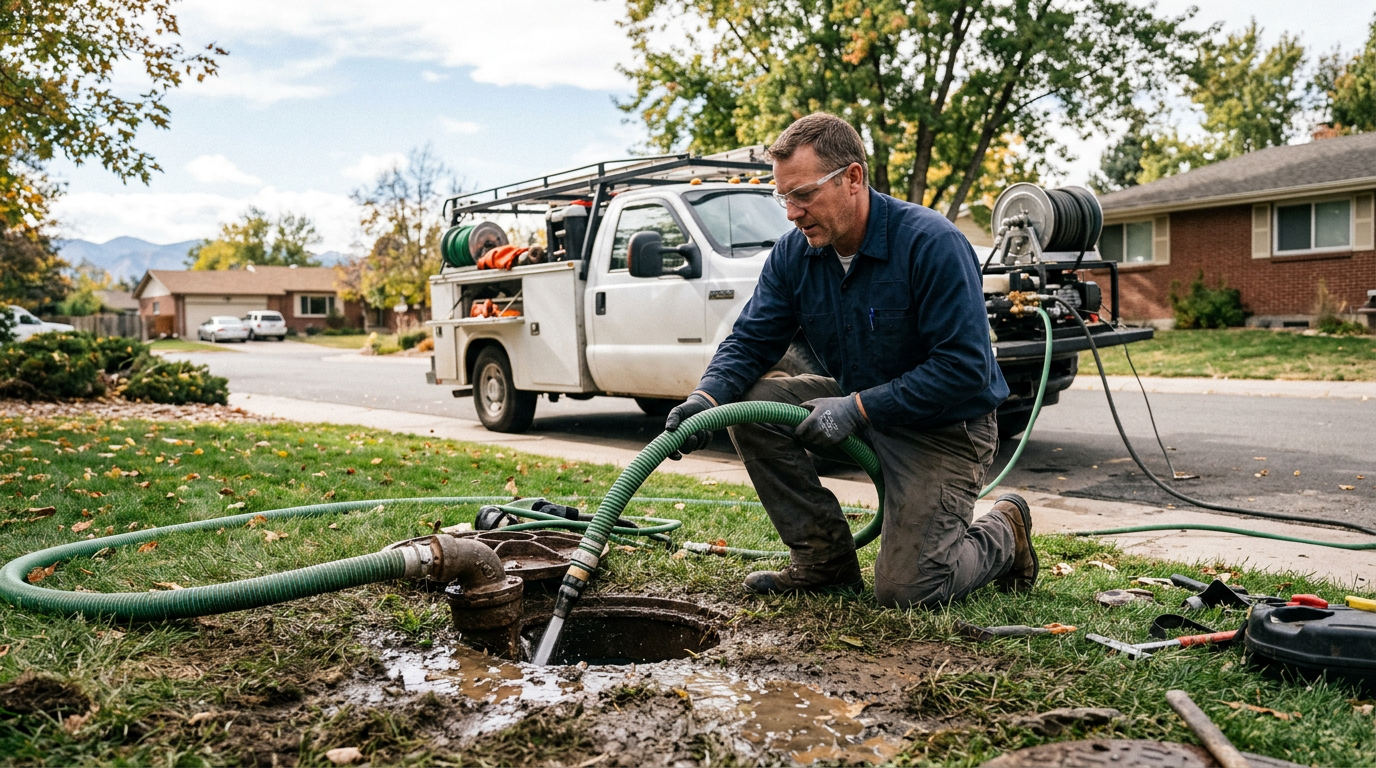
The short answer
When comparing hydro jetting vs snaking for a Centennial main sewer line, snaking punches a relief hole through soft clogs using a spinning steel cable, while hydro jetting scours 100% of the pipe wall using water pressurized up to 4,000 PSI. Snaking offers lower upfront costs for quick emergency clearance, whereas hydro jetting removes scale, heavy grease, and stubborn roots for longer-lasting results.
Key takeaways
- Mechanical snaking punctures localized clogs to restore emergency flow but leaves sludge and grease residue along pipe perimeters.
- Hydro jetting utilizes 3,000 to 4,000 PSI water streams to emulsify fats, strip mineral scale, and shave tree roots flush with pipe walls.
- Typical Centennial sewer snaking ranges broadly between $175 and $350, while hydro jetting generally spans $450 to $900 depending on access and lateral length.
- A sewer camera diagnostic check is necessary before jetting to ensure older clay or cast iron lines can safely handle high-pressure washing.
- Selecting hydro jetting extends the operational window between routine cleanings compared to mechanical cabling alone.
Homeowners and property managers evaluating hydro jetting vs snaking for a compromised main sewer lateral in Centennial must balance immediate line clearance against long-term cleaning efficacy. While traditional mechanical rooter cables puncture through solid obstructions to relieve standing wastewater, high-pressure hydro jetting actively scrubs the full internal diameter of the line. Understanding how these tools function, where they succeed, and what they typically cost allows Centennial property owners to choose the right drain cleaning service for their specific piping conditions.
What Distinguishes High-Pressure Water Flushing from Mechanical Cable Clearing?
Hydro jetting and mechanical snaking differ fundamentally in how they apply physical force to clear underground sewer obstructions. A drain snake relies on a continuous wound-steel cable driven by an electric motor, rotating specialized cutting heads, blades, or retrieval corkscrews directly through a blockage. The auger head focuses its mechanical torque on the obstruction itself, chewing through toilet paper wads, foreign objects, and localized root masses to establish a pathway for water drainage.
In contrast, hydro jetting operates by pumping filtered water through a specialized flexible hose rated for high working pressures, typically between 3,000 and 4,000 PSI at flow rates of 6 to 18 gallons per minute. The specialized nozzle at the hose tip features a forward-facing cutting jet to blast through forward blockages, paired with multiple reverse-facing jets angled backward at 30 to 45 degrees. These rear jets propel the nozzle down the pipe while simultaneously scouring the interior walls 360 degrees around, sweeping dislodged debris back toward the downstream municipal main.
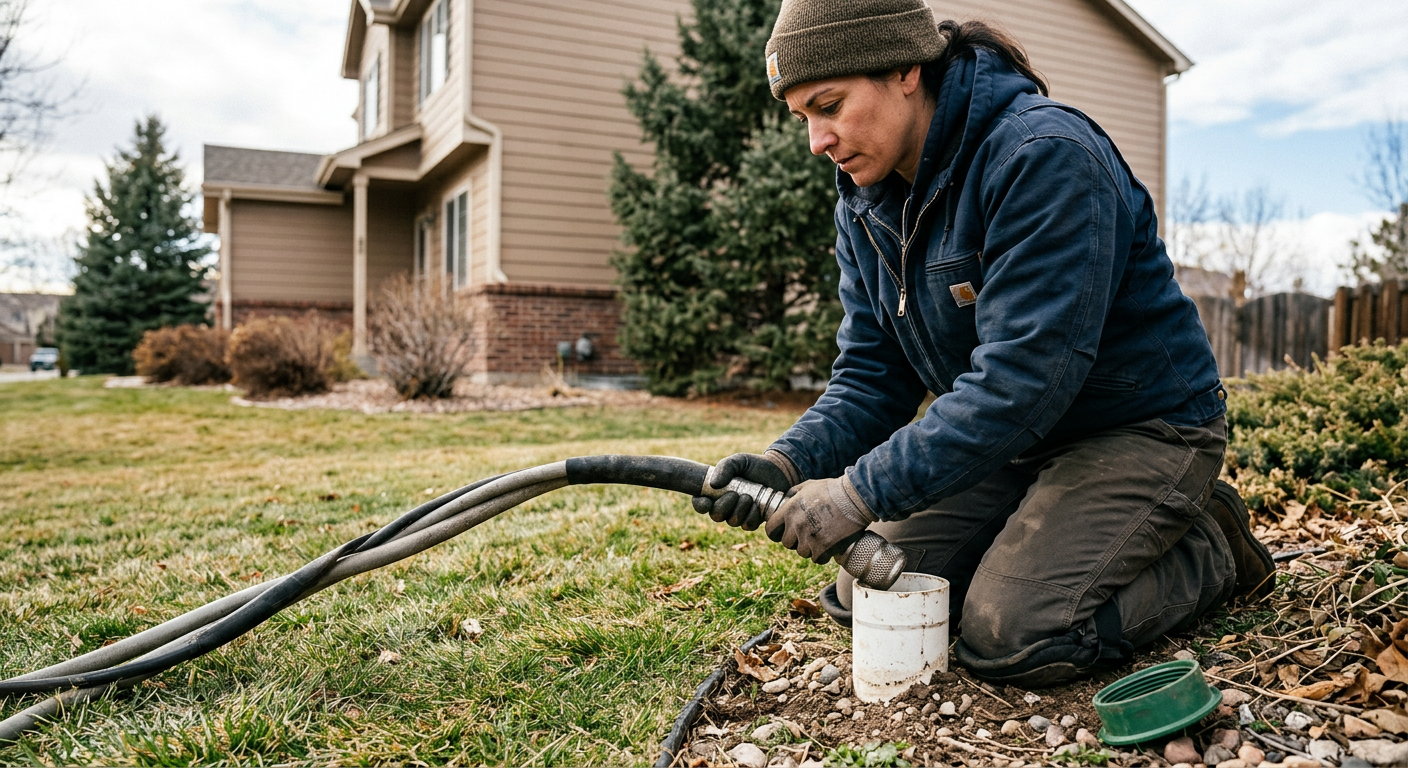
How Do Snaking Blades and Water Jet Nozzles Interact with Pipe Obstructions?
The physical interaction between a cleaning tool and the pipe wall determines whether a main line is merely opened or completely restored. When technicians deploy rooter service equipment across Centennial properties, the physical nature of the clog dictates tool performance.
Piercing Localized Blockages with Continuous Steel Cables
Mechanical cabling uses rotational torque to drive a narrow cutting tip directly through the path of least resistance within the sewer lateral. Because standard sewer lines measure 4 to 6 inches in diameter while most cable blades measure 2 to 3 inches, the machine punches an aperture through the center of the obstruction without contacting every square inch of the internal perimeter. This technique works efficiently for puncturing solid objects or relieving a full basement backup quickly, but it routinely leaves rings of hardened waste, mineral buildup, and peripheral grease behind.
Stripping Pipe Circumferences Clean with Targeted Water Streams
Hydro jet nozzles harness fluid dynamics to strip pipe perimeters down to the bare host material without applying rigid mechanical friction against aged joints. As the nozzle travels down the line, high-velocity water streams break the cohesive surface tension of thick fats, emulsify solidified oils, and shear invasive root strands directly at the pipe seam. For households dealing with recurring waste accumulation, exploring managing kitchen grease clogs in Centennial highlights why fluid flushing is often necessary to prevent immediate re-clogging.
Blockage Breakdown: Which Technique Resolves Specific Waste Line Issues?
Selecting the correct clearing procedure depends entirely on whether the obstruction stems from organic sludge, intrusive foliage, foreign debris, or internal pipe scale. Aurora Drainage Service technicians evaluate the underlying clog composition before recommending cable clearing or high-pressure flushing.
- Heavy Fats, Oils, and Grease (FOG): Mechanical snaking merely bores a temporary hole through cold grease masses, allowing the sticky residue to collapse back inward once the cable is withdrawn. Hydro jetting completely emulsifies and flushes grease deposits out of the plumbing system.
- Fine Feeder Roots and Fibrous Mats: Snaking tears a pathway through root clusters, leaving root stems protruding from pipe joints. Hydro jetting cuts fine feeder root mats flush against the pipe wall, delaying regrowth cycles significantly.
- Foreign Objects and Hard Obstructions: When non-dispersible items such as wet wipes, small toys, or heavy cloth lodge in a lateral, mechanical snaking with a retrieval hook is often more effective at snagging and extracting the item than water pressure.
- Mineral Scale and Rust Tubercles: Aging cast iron sewer lines develop rough internal ridges known as tuberculation. Snaking cannot remove this scale, whereas specialized descaling jetter heads polish the cast iron surface to restore smooth flow dynamics.
| Performance Factor | Mechanical Snaking / Cabling | High-Pressure Hydro Jetting |
|---|---|---|
| Primary Mechanism | Rotational steel torque & cutting heads | High-pressure hydraulic water scouring |
| Working Pressure / Force | Low-to-medium mechanical torque | 3,000 to 4,000 PSI water stream |
| Pipe Diameter Coverage | Partial (cores 2-3 inch center path) | Complete (360-degree internal scrubbing) |
| Grease Removal Capability | Low (punctures without emulsifying) | High (emulsifies and flushes residue) |
| Fine Root Clearing | Moderate (trims core of root mass) | High (shears roots flush to joint wall) |
| Typical Service Duration | 45 to 90 minutes | 90 to 180 minutes |
| Typical Centennial Cost Range | $175 – $350 (standard access) | $450 – $900 (includes camera verification) |
Analyzing the Financial Outlay: Hydro Jetting vs Snaking Investment in Centennial
Cost expectations for sewer clearing in Centennial depend on the clearing methodology, access point availability, and the total run length to the municipal main. A standard mechanical snaking service generally ranges from $175 to $350 for typical residential laterals with an accessible ground-level cleanout. If a technician must pull a basement toilet or access the line from a roof vent, labor time increases, pushing cabling costs toward the upper end of that spectrum.
Comprehensive hydro jetting service generally falls between $450 and $900 for residential properties across the Centennial and Denver Metro area. This higher price point reflects the specialized industrial equipment, high-volume water hookups, and the mandatory pre- and post-clearing camera inspections required to ensure pipeline safety. For commercial properties, such as Centennial restaurants or multi-tenant retail spaces, commercial drain cleaning packages may vary higher based on pipe diameter, grease volume, and after-hours execution.
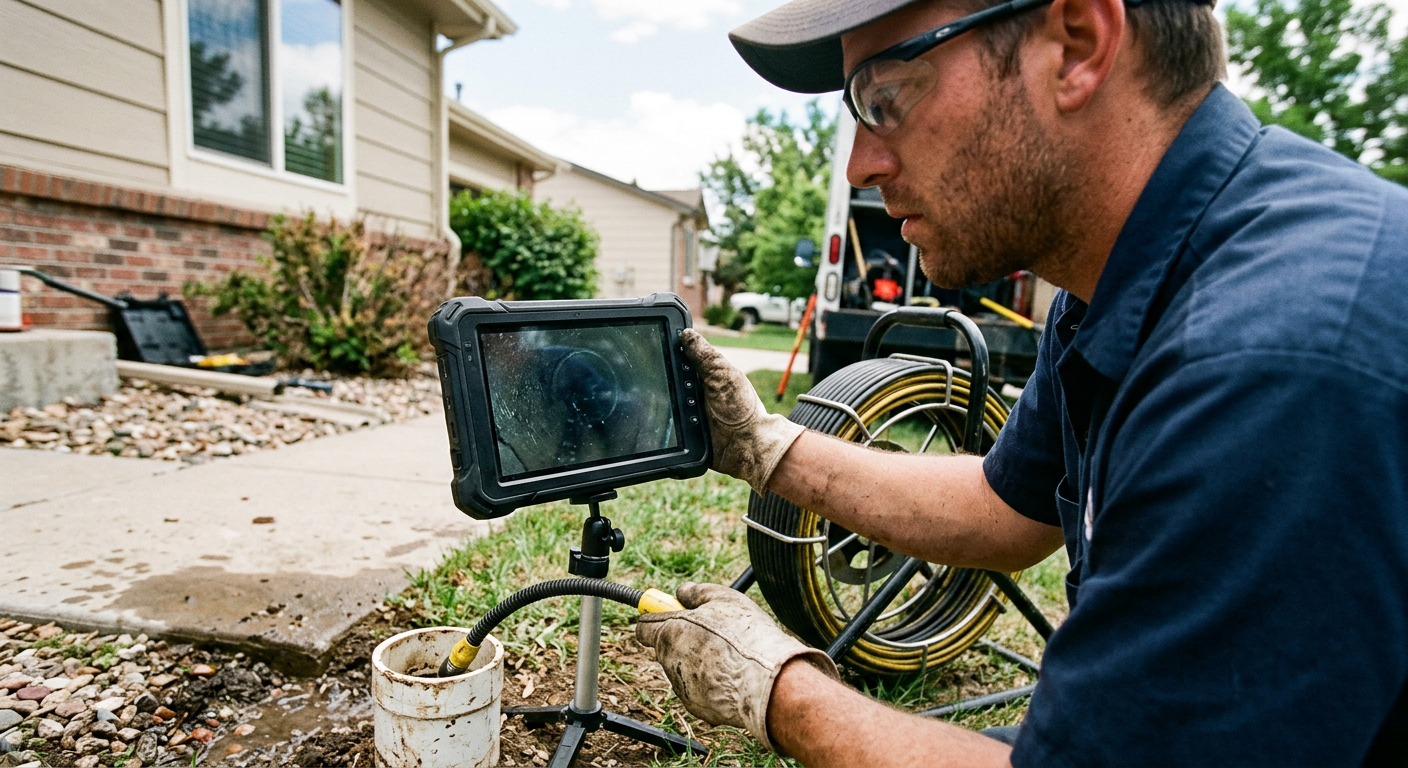
Why Pre-Cleaning Pipe Inspections Protect Older Centennial Waste Lines
Performing a sewer camera diagnostic before initiating high-pressure jetting protects aging Centennial sewer pipes from structural compromise. Many established residential neighborhoods in Centennial feature original vitrified clay or vintage cast iron sewer laterals installed decades ago. Over time, shifting Colorado clay soils and invasive root systems can create hairline fractures, offset joints, or thin pipe walls beneath the yard.
A technician inserts a self-leveling color camera through the lateral to visually evaluate the structural integrity of the line prior to applying water pressure. If the camera reveals collapsed sections, severe pipe bellies with deep standing water, or missing pipe floor sections in cast iron, high-pressure jetting is bypassed in favor of mechanical cabling or structural pipe repair. Conversely, if the pipe walls remain structurally sound, camera verification confirms that the lateral can safely withstand full hydro jetting scouring without risk of hydraulic blowout.
Routine Maintenance Value: How Clearing Method Impacts Future Service Intervals
Choosing hydro jetting significantly extends the operational lifespan between required drain service visits compared to standard cabling. Because mechanical snaking leaves residual fats, scale, and root fragments clinging to the pipe walls, downstream waste catches on these rough contact points within months. Property owners seeking guidance on system scheduling can consult our main line cleaning frequency recommendations to structure an effective preventative schedule.
By washing away all interior debris and restoring the pipe to its maximum inner diameter, hydro jetting allows sewage and solids to move at their designed flow velocity. In Front Range soils where tree roots aggressively hunt pipe seams for moisture during dry summer months, shearing root tips flush with the wall dramatically slows re-entry. Property owners can browse our Aurora drainage blog archive for additional insights on managing residential sewer laterals and commercial drain lines across the metro area.
Resolving Main Lateral Stoppages with Aurora Drainage Service
When deciding on hydro jetting vs snaking for your property, Aurora Drainage Service delivers straightforward diagnostics and expert line restoration across Centennial and the surrounding Denver Metro area. As a family-owned and operated team based right here in Aurora, Colorado, our technicians operate specialized mechanical rooters and commercial-grade hydro jetting equipment 24 hours a day, 7 days a week. We inspect your main line thoroughly, explain your practical cleaning options without pressure, and restore your drainage system quickly and effectively.
Frequently asked questions
- Can mechanical snaking permanently clear tree roots from a main sewer lateral?
- Mechanical snaking cannot permanently eliminate tree roots because the spinning steel cutting blades only core out a path through the center of the root ball, leaving structural root collars intact at pipe joints to regrow rapidly.
- Is high-pressure hydro jetting safe for older vitrified clay sewer pipes in Centennial?
- High-pressure hydro jetting is safe for vitrified clay pipes only if the structural integrity of the line is confirmed beforehand through a high-resolution sewer camera inspection that checks for severe fractures or joint collapses.
- How long does a professional hydro jetting service take compared to snaking?
- A standard mechanical snaking appointment typically takes 45 to 90 minutes, whereas a thorough hydro jetting service generally requires 1.5 to 3 hours to perform pre-inspection, multiple pressure passes, and post-clearing camera verification.
- Why does my main sewer line back up again within months after being snaked?
- Recurrent backups after snaking occur because the auger merely punches an opening through soft blockages, leaving thick layers of grease, scale, and root remnants clinging to the interior pipe walls that quickly snag new waste.
Talk to
Describe what you're seeing and we'll tell you what the next step looks like.
Keep reading
Kitchen Drain Grease Buildup Prevention Playbook
Learn how cooking fats solidify inside plumbing lines, why Centennial soil temperatures accelerate clogs, and how professional drain cleaning removes stubborn kitchen grease buildup.
Kitchen Drain Grease Buildup: Centennial Prevention and Maintenance Guide
Discover how kitchen drain grease buildup forms in residential plumbing, why Colorado ground temperatures worsen pipe deposits, and practical prevention steps to maintain free-flowing waste lines in Centennial.
How Often Should a Main Line Be Cleaned? Aurora Sewer Line Cleaning Guide
Discover the ideal sewer main line cleaning frequency for Aurora homes and businesses, factoring in pipe age, mature trees, Front Range soils, and heavy waste demands.