Trenchless sewer repair · Denver
Evaluating Trenchless Sewer Repair Denver Solutions for Residential Properties
By , · Published August 18, 2026 · 2,350 words
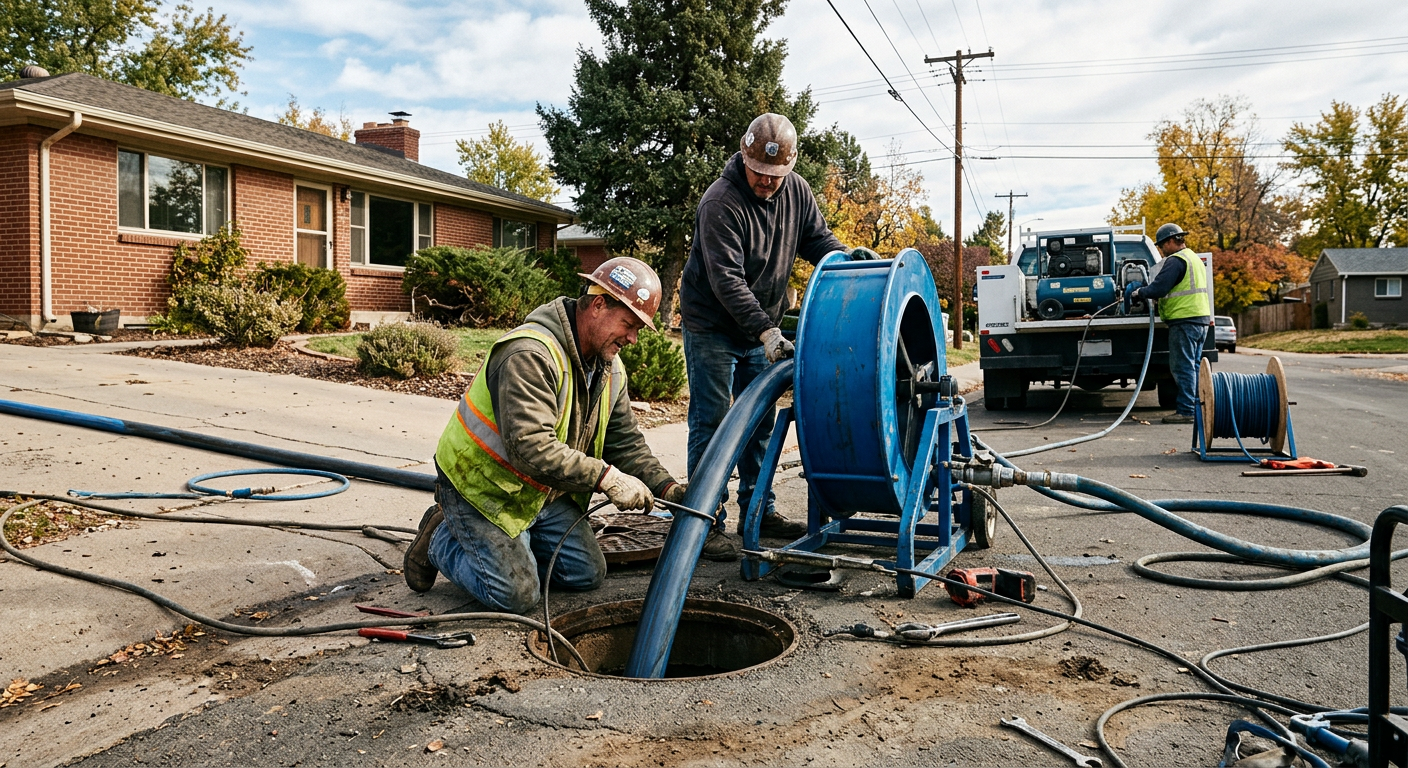
The short answer
Trenchless sewer repair restores damaged residential lateral pipes through cured-in-place pipe (CIPP) lining or pneumatic pipe bursting with minimal landscape excavation. In Denver, suitability depends on host pipe grade, structural integrity, and absence of severe bellies. Technicians confirm eligibility through video camera inspections to ensure the line can support seamless structural rehabilitation.
Key takeaways
- CIPP lining creates a jointless resin pipe inside the existing host pipe, while pipe bursting fractures the old line and pulls through seamless HDPE.
- Lines with severe pipe belly depressions, back-pitch, or complete collapses require localized excavation rather than pure trenchless methods.
- A continuous high-resolution sewer camera inspection is mandatory to evaluate pipe integrity, diameter transitions, and lateral connections.
- Expansive Front Range clay soils make seamless trenchless pipe solutions highly resistant to future offset joints and root infiltration.
- Most residential trenchless projects in the Denver metro area are completed in one to two days with minimal landscape disruption.
For homeowners facing chronic sewer backups in older neighborhoods, modern trenchless sewer repair denver services provide a way to rebuild collapsed or root-choked lateral pipes without destroying driveways, mature trees, or manicured lawns. Rather than digging a continuous six-to-eight-foot-deep trench across a property from the foundation to the municipal main, field technicians use localized access points to install new structural piping. Understanding which trenchless method fits your plumbing layout requires a clear look at underground structural conditions, pipe materials, and local soil mechanics across the Front Range.
What underground pipe defects make a property eligible for trenchless restoration?
Aurora Drainage Service evaluates lateral sewer lines across Denver to confirm whether an underground pipe has enough structural form to accept trenchless rehabilitation. While modern no-dig techniques resolve severe structural flaws, the existing pipe must still possess a continuous channel to guide either a bursting head or an epoxy-saturated felt tube. When underground conduits suffer from localized cracking, misaligned clay joints, or isolated punctures, trenchless engineering provides an ideal, minimally invasive alternative to full-yard excavation.
Trenchless repairs work exceptionally well for properties experiencing recurring root intrusion sewer events where root bundles repeatedly breach brittle vitrified clay tile or aging cast iron seams. Over decades, expansive soil shifting along the Front Range forces pipe sections out of alignment, creating gaps where moisture escapes and feeder roots penetrate. A trenchless solution seals these entry points permanently by eliminating mechanical joints.
- Vitrified clay lines with heavy root penetration at every four-foot joint segment.
- Aging cast iron laterals showing internal scale buildup, channeling along the bottom, and hairline corrosion cracks.
- Pipes passing directly beneath permanent hardscaping, established trees, retaining walls, or concrete patios.
- Older Orangeburg (bituminized fiber) pipes that have lost roundness but have not suffered complete mechanical collapse.
How does the mechanical pull of pipe bursting install seamless HDPE through deteriorated lines?
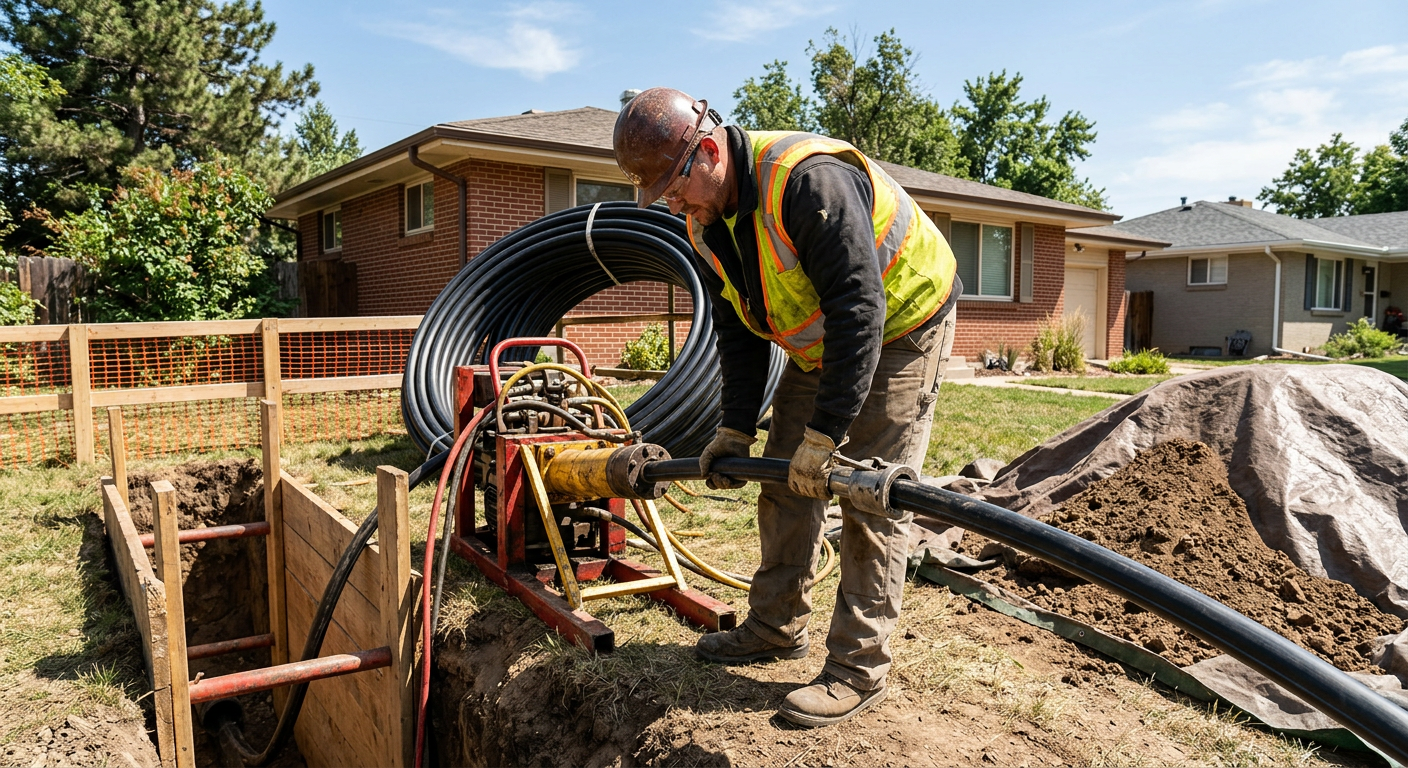
Pipe bursting replaces brittle underground pipes in Denver by pulling a hardened steel expanding head through the host pipe to fracture it outward while simultaneously towing a continuous high-density polyethylene (HDPE) line behind it. This method does not rely on the structural integrity of the old pipe; instead, the original line is destroyed and pushed into the surrounding soil envelope. Because the replacement HDPE pipe is butt-fused together with heat, it forms a monolithic, continuous conduit that possesses no joints where tree roots or shifting ground can compromise the line.
The installation begins by excavating two small access points: an entry pit near the foundation or property line and an exit pit where the lateral connects to the city sewer main or property boundary. A heavy-duty steel wire pulling cable is threaded through the old pipe from the exit pit back to the entry pit. Technicians attach the cone-shaped bursting head to the cable and secure the lead end of the fused HDPE pipe to the rear of the head.
A hydraulic pulling machine stationed in the exit pit exerts dozens of tons of steady pulling force on the cable. As the conical head advances, its expanding diameter splits the host vitrified clay, cast iron, or PVC pipe. The fragments are displaced outward into the surrounding earth bed, and the brand-new HDPE line immediately occupies the void. For homes requiring clay sewer pipe replacement, pipe bursting is often the preferred choice because it allows technicians to maintain or even slightly increase the internal pipe diameter without extensive trenching.
Managing entry and exit pits in tight urban Denver yards
Excavation pits for pipe bursting in urban Denver neighborhoods like Wash Park or the Highlands are strategically sized to protect mature landscaping and adjacent property boundaries. The entry pit typically measures roughly four feet wide by six to eight feet long, dug to the precise depth of the sewer lateral, which often sits between six and nine feet deep in metro Denver. Technicians protect turf with plywood sheeting and stage soil on heavy tarps to ensure the yard can be restored smoothly after backfilling and mechanical compaction.
What technical steps govern cured-in-place pipe relining from cleaning to resin hardening?
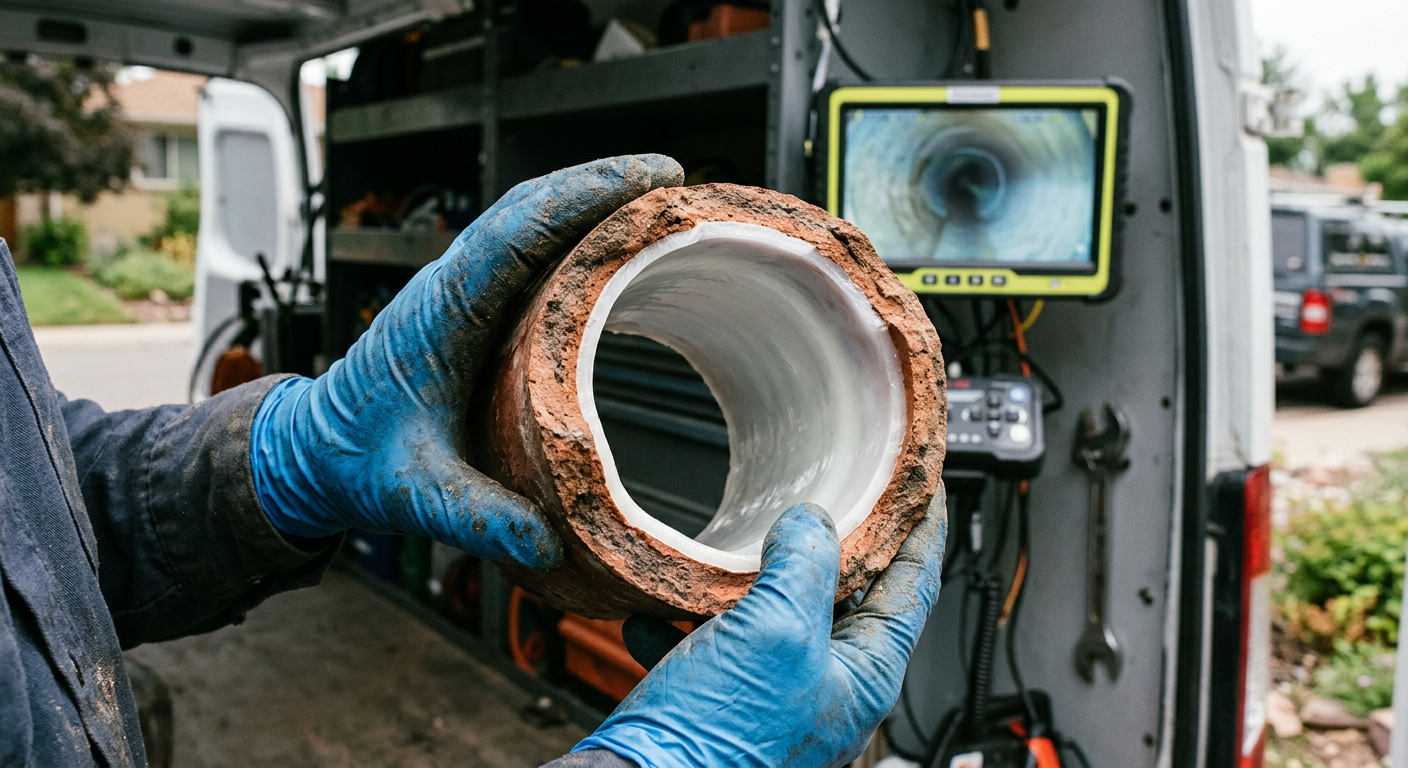
Cured-in-place pipe (CIPP) lining rehabilitates existing Denver sewer pipes by inserting a flexible, epoxy-saturated felt tube into the host line and inflating it until the resin cures into a smooth, structural pipe-within-a-pipe. This no-dig approach requires only a single access point, such as an exterior sewer cleanout or a small interior basement access. Once cured, the epoxy liner measures several millimeters in thickness, restoring hydraulic capacity and bridging cracked sections without excavating the yard.
The process demands immaculate pipe preparation. If grease, mineral scale, or root fragments remain on the host pipe walls, the resin tube cannot make uniform contact, leading to voids, wrinkles, or liner failure. Technicians first perform aggressive mechanical scraping and hydro scrubbing to strip the interior back to bare substrate before taking exact length and diameter measurements with specialized calibrated cameras.
Mechanical descaling and scouring prior to sleeve inversion
Denver lateral lines must be meticulously cleared of all interior scale, roots, and debris before a resin liner is introduced into the pipe. Technicians utilize high-speed mechanical chain knockers and scouring nozzles to remove decades of rust tuberculation and calcium deposits from cast iron or clay walls. Homeowners looking for drain cleaning near me often discover during this preparatory descaling phase whether their line is solid enough for lining or if deep structural decay requires bursting.
| Engineering Factor | Pipe Bursting (HDPE) | CIPP Lining (Epoxy) | Traditional Open Trench |
|---|---|---|---|
| Primary Mechanism | Fractures old pipe, pulls seamless HDPE | Inverts epoxy felt tube inside host pipe | Excavates entire trench to lay new pipe |
| Required Access | Two small pits (entry and exit) | Single cleanout or small single pit | Continuous open trench along entire line |
| Impact on Pipe Diameter | Maintains or increases original diameter | Reduces internal diameter by ~4-6mm | Can install any specified pipe diameter |
| Applicability to Collapsed Pipes | Yes, if guide cable can pass through | No, requires intact host pipe geometry | Yes, clears all collapsed material |
| Yard & Surface Disruption | Minimal (localized to 2 small pits) | Near zero (uses existing cleanouts) | Major (destroys lawns, walks, driveways) |
| Average Project Duration | 1 to 2 field days | 1 to 2 field days | 3 to 5 field days plus restoration |
Why do severe ground bellies and complete channel collapses eliminate no-dig options?
Severe pipe bellies, extreme back-pitch, and total structural collapses in Denver lateral lines prevent successful trenchless rehabilitation because neither lining nor bursting can re-grade the underground slope. Sewer laterals rely on gravity to move solid waste and gray water toward the municipal main at an engineered drop of roughly one-quarter inch per foot. When expansive bentonite clay shifts beneath a pipe, creating a low spot that holds standing water, a trenchless liner will simply conform to that dip, leaving the drainage defect unresolved.
When a pipe suffers a complete structural collapse where soil fills the void, pulling cables and inversion bladders cannot navigate the blockage. In these scenarios, technicians must perform a targeted spot repair or full open-trench excavation to dig out the failed section, reconstruct the gravel foundation, and re-establish proper flow pitch. Properties experiencing a sudden, catastrophic main line backup often require immediate camera diagnostics to determine whether the pipe structure has pancaked or merely suffered an isolated joint offset.
- Pipe Bellies (Sags): Depressions where water stands continuously cannot be leveled by CIPP lining or standard pipe bursting.
- Reverse Grade (Back-Pitch): Sections sloping backward toward the house require physical re-excavation and grade correction.
- Complete Void Collapse: Crushed lines where the interior channel is obstructed by compacted soil prevent guide cable routing.
- Severe Shear Offsets: Sharp vertical breaks where pipe ends have separated by several inches cannot support smooth liner transitions.
What diagnostic checks confirm whether trenchless sewer repair denver properties need is feasible?
Aurora Drainage Service uses high-resolution CCTV sewer camera inspections to confirm whether trenchless sewer repair denver homes need is structurally and geographically viable. The technician introduces a self-leveling optical camera equipped with a built-in 512 Hz sonde transmitter down the lateral line. As the camera travels from the home cleanout to the city main, the technician monitors the video feed for joint offsets, wall thinning, root infiltration density, and standing water indicators.
Conducting a thorough sewer scope before buying a house or prior to scheduling a major lateral repair reveals critical physical variables that define the job scope. The technician maps the exact depth and path of the lateral across the yard using an above-ground digital locator wand, marking any underground utility crossings such as gas lines, electrical conduits, or water mains.
- Continuous CCTV Video Survey: Verifies the physical continuity, wall thickness, and interior roundness of the entire host lateral.
- Electromagnetic Sonde Locating: Maps the exact depth, surface trajectory, and grade of the pipe across the yard to locate ideal pit locations.
- Secondary Lateral Identification: Locates points where basement branch lines, foundation drains, or a sump pump discharge line enter the main lateral.
- Utility Cross-Bore Verification: Ensures no third-party utilities (such as directional-drilled gas lines) have penetrated the sewer conduit.
What realistic cost factors and timeline variables define Denver no-dig rehabilitations?
Trenchless sewer repairs across the Denver metropolitan area typically range from $6,000 to $14,000, depending on the overall length of the line, burial depth, and site accessibility. While the initial equipment and material investment for trenchless methods is comparable to open excavation, homeowners save substantially on secondary surface reconstruction. Conventional digging can add thousands of dollars in hidden expenses to rebuild asphalt driveways, flagstone walkways, decorative retaining walls, and custom landscaping.
A standard residential trenchless project in Denver usually takes between one and two working days to complete. Day one involves locating utilities, digging the small entry and exit pits, and cleaning the host pipe. The bursting pull or CIPP liner inversion takes place that afternoon or the following morning, followed by reinstatement of any secondary tie-ins and a final recorded video inspection before backfilling and compacting the pits.
How should homeowners evaluate maintenance routines after undergoing underground pipe renewal?
Once a Denver home has undergone trenchless sewer lateral restoration, ongoing maintenance shifts from emergency root clearing to standard preventative plumbing care. Because seamless HDPE pipe and epoxy CIPP liners have completely smooth interior surfaces with no mortar joints, grease and debris move much more freely toward the city collection main. However, homeowners must still avoid flushing non-dispersible wipes, heavy paper products, and cooking fats that can solidify in building drains.
If a property also deals with heavy roof runoff or surface water accumulation, coordinating exterior drainage upgrades like a storm drain installation prevents groundwater saturation from placing excessive hydraulic pressure around foundation footings and buried lateral lines. You can browse our full Blog archive for detailed field articles on drain maintenance, mechanical clearing, and diagnostic sewer camera inspections.
Evaluating whether your property is an ideal candidate for trenchless sewer repair denver specialists provide begins with an honest camera inspection. By selecting the right no-dig methodology—whether high-strength pipe bursting or precision epoxy lining—homeowners protect their landscaping, eliminate root infiltration permanently, and restore reliable lateral flow for decades to come.
Frequently asked questions
- How long does a trenchless sewer replacement take to complete?
- Most residential trenchless sewer projects take one to two days from site setup to final camera verification. Small insertion pits are dug on the first morning, the bursting or lining process takes several hours, and tie-ins and utility inspections are completed the following day.
- Can trenchless sewer repair fix a low spot or belly in a sewer line?
- No, trenchless lining and pipe bursting cannot eliminate severe bellies or reverse slope issues. Lining follows the existing contour of the host pipe, and bursting heads follow the existing path. Lines with standing water pockets require open excavation to re-grade the bedding gravel.
- Will tree roots ever penetrate a newly installed trenchless pipe?
- Tree roots cannot penetrate a properly cured epoxy liner or continuous HDPE pipe because neither method leaves open mechanical joints. Unless an external force fractures the pipe material or a secondary lateral tie-in is left unsealed, root entry is physically blocked.
- What is the primary difference between pipe lining and pipe bursting?
- Pipe lining inserts a resin-saturated felt tube inside the existing damaged host pipe, curing it into a rigid pipe-within-a-pipe that slightly reduces internal diameter. Pipe bursting uses an expanding steel head to break apart the old line while simultaneously pulling a brand-new, full-diameter HDPE pipe into its place.
Talk to
Describe what you're seeing and we'll tell you what the next step looks like.
Keep reading
Kitchen Drain Grease Buildup Prevention Playbook
Learn how cooking fats solidify inside plumbing lines, why Centennial soil temperatures accelerate clogs, and how professional drain cleaning removes stubborn kitchen grease buildup.
Hydro Jetting vs Snaking a Main Drain: Centennial Comparison and Cost Expectations
Evaluate the technical capabilities and cost differences between hydro jetting and mechanical snaking for clearing stubborn main sewer obstructions in Centennial homes and commercial properties.
Kitchen Drain Grease Buildup: Centennial Prevention and Maintenance Guide
Discover how kitchen drain grease buildup forms in residential plumbing, why Colorado ground temperatures worsen pipe deposits, and practical prevention steps to maintain free-flowing waste lines in Centennial.